
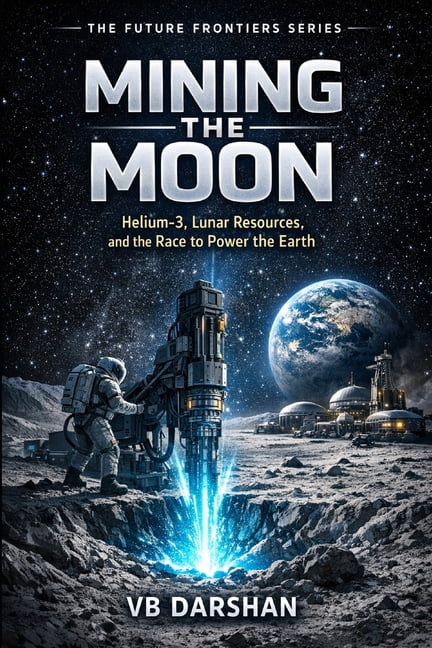
Mining the Moon: Helium-3, Lunar Resources, and the Race to Power the Earth, (Paperback)
Product details
| Management number | 238629318 | Release Date | 2026/07/11 | List Price | US$8.00 | Model Number | 238629318 | ||
|---|---|---|---|---|---|---|---|---|---|
| Category | |||||||||
<p><b><i>The Moon is not barren. It is a warehouse - and the race to claim it has already begun.</i></b></p><p><b><i>Buried in the lunar soil is a resource that exists on Earth in quantities so tiny they are almost fictional: Helium-3, an isotope implanted by four billion years of solar wind, capable of fueling a new generation of fusion reactors that could power human civilization for thousands of years - cleanly, without carbon emissions, without radioactive waste. Whoever extracts it may control the energy future of the planet.</i></b></p><p><b><i>But Helium-3 is only part of the story.</i></b></p><p><b><i>The Moon's permanently shadowed polar craters contain hundreds of millions of tonnes of water ice - confirmed by the LCROSS impact mission in 2009. That ice is not merely water. It is rocket propellant, breathable oxygen, and the economic foundation of a permanent human presence beyond Earth. Its discovery transformed the Moon from a scientific curiosity into the most strategically valuable real estate in the solar system.</i></b></p><p><b><i>In Mining the Moon, journalist, historian, and geopolitical analyst VB Darshan examines every dimension of this emerging frontier: </i></b></p><p><b><i>The Science. How the Moon formed from a planetary collision 4.5 billion years ago, what resources it accumulated across geological time, and why its polar craters are among the coldest - and scientifically richest - places in the inner solar system.</i></b></p><p><b><i>The Technology. How you mine in vacuum, in low gravity, with robots that cannot be repaired and equipment that must survive 300-degree temperature swings. What autonomous AI systems, electromagnetic mass drivers, and in-situ resource processing actually look like - and how far from readiness they truly are.</i></b></p><p><b><i>The Economics. The supply chain from lunar regolith to cislunar propellant depot to Earth market. The break-even calculations. Which resource streams have real near-term commercial viability - and which depend on a fusion reactor that has not yet been built.</i></b></p><p><b><i>The Geopolitics. The United States has Artemis. China has the International Lunar Research Station. India landed at the south pole in 2023. All three are targeting the same geography, under different legal frameworks, with no agreed rules for what happens when they meet at the same crater. The 1967 Outer Space Treaty says the Moon belongs to no one. It does not say who owns what they extract.</i></b></p><p><b><i>The Law. The Outer Space Treaty's critical silence on resource ownership. The Artemis Accords that 23 nations have signed - and China and Russia have not. The legal vacuum that is narrowing with every launch, and the governance framework that must be built before the first serious conflict erupts at the lunar south pole.</i></b></p><p><b><i>The Ethics. Does the Moon have intrinsic value? Who decides how its resources are distributed? Why are the communities most in need of the energy security it could provide the communities with the least voice in how it is governed?</i></b></p>
- Mining the Moon: Helium-3, Lunar Resources, and the Race to Power the Earth, (Paperback)
- Author: Independently Published
- ISBN: 9798257395741
- Format: Paperback
- Publication Date: 2026-04-14
- Page Count: 294
| Book format | Paperback |
|---|---|
| Fiction/nonfiction | Non-Fiction |
| Genre | Political & Social Sciences |
| Publication date | April, 2026 |
| Pages | 294 |
| Subgenre | International Relations |
| Series title | No Series |
| Number in series | 0 |
| Edition | 1 |
| Publisher | Amazon Digital Services LLC - Kdp |
| Language | English |
| Edu focus | Technology |
| Is collectible | N |
| Recording time | 0 min |
| Retail packaging | Single Piece |
| Assembled product dimensions (l x w x h) | 6.00 x 0.62 x 9.00 in |
| Assembled product weight | 0.87 lb |
| Bisac subject heading | Political Science |
Bestseller ranking
All Books



Customers who viewed this product also viewed
Nitinol Wire


Correction of product information
If you notice any omissions or errors in the product information on this page, please use the correction request form below.
Correction Request Form